

Why Hearing in Noise Feels Impossible
Imagine sitting at a crowded restaurant. Laughter, clinking glasses, and overlapping conversations swirl around you. You see your friend’s lips move, but the words don’t come through. You nod along, pretending to follow. This isn’t just a bad day-it’s daily life for millions with hearing loss. Even the best hearing aids struggle here. Why? Because sound weakens as distance grows. Every time you double the distance from the speaker, the speech signal drops by 6 decibels. At 4 feet away, it’s already half as loud. Add background noise, and understanding speech becomes a guessing game.
What Remote Microphone Systems Actually Do
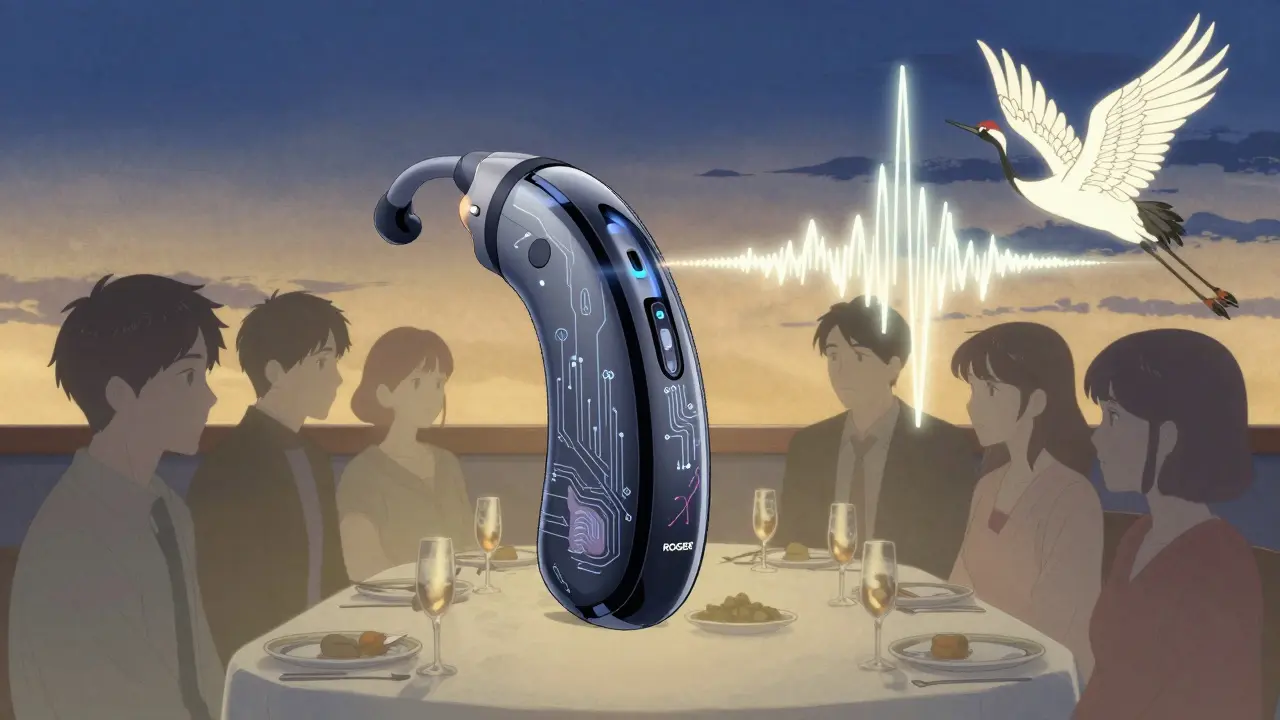
Remote microphone systems cut through this problem. They’re small wireless mics-like a clip-on device or pen-shaped gadget-that you give to the person you’re talking to. It picks up their voice right at the source, just 6 to 8 inches from their mouth. Then, it sends that clean signal straight to your hearing aids or cochlear implants via radio. No more waiting for sound to travel across a noisy room. The speech arrives clear, loud, and focused. It’s not magic. It’s physics. By bypassing distance and noise, these systems restore what hearing aids alone can’t.
The Tech Behind the Sound
Older systems used FM radio signals on fixed frequencies. They were prone to interference-static bursts from other devices, bad reception in buildings. Modern systems like Phonak Roger and ReSound Multi Mic use 2.4 GHz digital modulation. That’s the same band as Wi-Fi, but smarter. They hop between frequencies automatically to avoid interference. The Roger Select, for example, adjusts its microphone direction based on where voices are coming from. If someone walks to your left, it shifts focus. The Roger Pen stays omnidirectional, good for group settings but less precise in noisy rooms. Battery life? Around 8 to 12 hours. Size? About the same as a large thumb. These aren’t bulky gadgets-they’re designed to be worn without drawing attention.
How Much Better Is It? Real Numbers
Studies show dramatic results. In a 75-decibel noisy environment-like a busy café-people using hearing aids alone understood about 30% of speech. With a Roger Select, that jumped to 91%. That’s a 61% improvement. For kids in classrooms, the gain was even higher. One 2021 study found speech recognition improved by up to 19.5 dB in noise. That’s not a small tweak. It’s the difference between missing half the conversation and catching nearly every word. Adults in group settings saw up to 70 percentage-point gains. In real terms: you go from nodding along to actually joining the chat.

Comparing Systems: What Works Best
Not all systems are the same. Directional mics like the Roger Select outperform basic omnidirectional ones like the ReSound Mini Mic by 15 to 20 percentage points in noisy rooms. Adaptive systems that adjust automatically beat fixed ones by 16% in tough listening spots like restaurants. Digital systems (DM) crush old FM tech-up to 28% better at 75 dBA noise. The Roger Focus II, released in 2023, lets you link multiple mics. If you’re at a dinner table with three people talking, each can wear one. The system blends them. Result? 45% better speech recognition than hearing aids alone in multi-person talks. That’s huge for family gatherings or team meetings.
Who Uses These Systems-and Why
Children with hearing loss use them in school at a rate of 75%. It’s standard care. For adults? Only 35% use them. Why the gap? Cost. These devices run $499 to $799. Medicare covers just 15% of the price. Most private insurance doesn’t cover them at all. That’s a barrier. But users who try them rarely go back. In a 2023 survey of 1,247 hearing aid users, 87% said dining out became easy. 78% could follow group talks. On Reddit, one user went from understanding 20% of family dinners to 85% with Roger Select. Another nurse said it added five years to her career. Satisfaction scores hover around 4.6 out of 5. The problem isn’t performance-it’s access.
Getting Started: What You Need to Know
You can’t just buy one online and plug it in. These are medical devices. You need an audiologist to fit them. That means 2 to 3 visits. They’ll program the receiver to match your hearing loss profile, teach you how to pair it with your hearing aids, and show you how to switch modes. Most users get comfortable in 2 to 4 weeks. Common mistakes? Placing the mic too far from the speaker. Keep it within 8 inches. Don’t hide it in a pocket. Use a lanyard. Keep spare batteries. Pairing is like connecting Bluetooth headphones-simple once you’ve done it once.
What People Don’t Tell You
There’s a social cost. Some users feel awkward asking others to wear the mic. One review on Trustpilot said, “People think I’m recording them.” That’s real. It’s not a flaw in the tech-it’s a social hurdle. Solutions? Normalize it. Say, “This helps me hear you better.” Most people are supportive once they understand. Also, these systems don’t work if multiple people talk at once without passing the mic. You still need to manage the conversation. But with Roger Focus II or future integrated systems, that’s changing.
The Future Is Integrated
The next wave isn’t separate mics. It’s built-in. Oticon’s 2024 More hearing aid has Roger tech inside. No extra receiver. No neckloop. Just the hearing aid. Phonak’s 2024 Roger X uses AI to separate voices in a crowd-another 9% boost. Starkey’s Evolv AI, coming late 2024, will auto-enhance speech without you lifting a finger. By 2027, 60% of new hearing aids will have this tech built in. Costs will drop. Insurance coverage might follow. The goal isn’t to carry a device. It’s to make hearing effortless.
Final Thoughts: Is It Worth It?
If you struggle to hear in restaurants, meetings, or group settings-even with hearing aids-this isn’t a luxury. It’s a necessity. The science is clear. The user reviews are loud. The technology works. The biggest obstacle isn’t performance. It’s cost and awareness. Talk to your audiologist. Ask if you’re a candidate. Try a demo. You might be surprised how much easier life becomes when you can finally hear what’s being said.









Kunal Kaushik
2 Feb, 2026
I use one of these at work in noisy call centers. Life changed. No more asking people to repeat themselves 5 times. Just clip it on and boom - clear as day. 🙌
Lorena Druetta
3 Feb, 2026
I am deeply moved by the profound impact these devices have on human connection. To hear a loved one's voice without strain is not merely a technological advancement-it is a restoration of dignity. I urge all healthcare providers to advocate for broader access.
Keith Harris
5 Feb, 2026
Let me guess-this is all funded by Big Hearing Aid™. They don't want you to know that simple earwax removal and vocal training can do the same thing. And why are these $800? Because they know you're desperate. Wake up.
Daz Leonheart
6 Feb, 2026
I was skeptical at first, but after trying a demo at my audiologist’s office, I cried. Not because I was sad-because I finally heard my daughter say 'I love you' without guessing. It’s not about tech. It’s about being present.
Coy Huffman
8 Feb, 2026
It's wild how something so small-just a mic the size of your thumb-can bridge the gap between isolation and inclusion. We build rockets to Mars but still struggle to make conversation easy for people who hear differently. Maybe the real innovation isn't in the device... it's in how we choose to use it.
Mandy Vodak-Marotta
9 Feb, 2026
Okay but let’s be real-my mom got one of these and now she’s literally walking around the house with it clipped to her shirt like a badge of honor. She tells everyone ‘this is my hearing superhero’ and refuses to take it off even when we’re watching Netflix alone. I thought she’d hate it, but now she says it’s the first time in 20 years she hasn’t felt like a burden at family dinners. Also she named it Barry. Barry the Mic. I’m not joking.
Zachary French
10 Feb, 2026
I’ve read every peer-reviewed paper on this. The real issue? The FDA approves these as ‘assistive devices’ not medical implants-so manufacturers can charge whatever they want. And the 91% improvement? That’s in controlled labs. In real life? Try a 100-decibel kitchen with a blender, dog barking, and three kids screaming. The mic picks up ALL of it. It’s not magic-it’s marketing with a fancy algorithm and a price tag that makes your eyes water. I’ve used three different models. None of them are perfect. Don’t let the hype blind you.
Nathan King
10 Feb, 2026
The empirical data presented here is undeniably compelling. One cannot ignore the statistically significant gains in speech intelligibility under noise-adverse conditions. However, one must also interrogate the socioeconomic architecture that renders such life-altering technology inaccessible to the very populations it is designed to serve. A 75% adoption rate among children versus 35% among adults is not merely a disparity-it is a moral failure.
Sherman Lee
10 Feb, 2026
I’ve been waiting for this tech to be exposed as a government mind-control experiment. You think the mic just picks up speech? Nah. It’s transmitting your thoughts to the NSA. That’s why they push it so hard in schools. You think your kid’s teacher is helping them learn? Nah. They’re harvesting neural patterns. I saw a guy in Walmart with one. He was whispering to himself. I know what he was saying. 😈
Samuel Bradway
11 Feb, 2026
My dad’s been using a Roger Select for six months now. He didn’t want to at first. Thought it made him look ‘old’ or ‘broken.’ Now he won’t leave the house without it. Last Sunday, he laughed so hard at my joke he spilled coffee. He hasn’t done that in years. Just wanted to say… thank you for writing this. It matters.
Harriot Rockey
12 Feb, 2026
To anyone reading this who’s thinking, 'I can’t afford it'-ask your audiologist about loaner programs, nonprofit grants, or even community hearing centers. I’ve seen people get them for free through local nonprofits. And if you’re hesitant because you’re scared people will judge you? Say it out loud: 'This helps me hear you.' Most folks will say, 'Oh, that’s so cool!' and then ask where to get one for their grandma. You’re not weird. You’re brave. 💙