

When your doctor prescribes a medication, you expect it to be covered by your insurance. But what if your insurer says you have to try cheaper drugs first-even if your doctor says they won’t work for you? That’s the reality of step therapy, a common insurance rule that forces patients to "fail" on lower-cost treatments before getting access to the one originally prescribed. It’s called a "fail-first" policy for a reason: you have to prove a cheaper option doesn’t work before the insurance will pay for the one your doctor believes is right.
How Step Therapy Actually Works
Step therapy isn’t random. It’s built into insurance formularies as a step-by-step ladder. At the bottom? Generic drugs. These are usually the first step. If you’re being treated for rheumatoid arthritis, for example, your insurer might require you to try methotrexate or an NSAID like ibuprofen before they’ll cover a biologic like Humira or Enbrel. If those don’t work-or cause side effects-you move up to the next step. Only then can you get the drug your doctor picked.This isn’t just about savings. It’s a structured system. The Virginia Code defines it clearly: a step therapy protocol is a "sequence in which prescription drugs for a specified medical condition are covered." Insurers like Aetna and Blue Cross Blue Shield of Michigan lay out these steps in their member guides. One patient might need to try three different drugs over six months before approval comes through. And during that time, their condition can get worse.
Why Insurers Use Step Therapy
Insurance companies say they do this to keep costs down. Prescription drug spending has soared, and insurers are under pressure to control it. According to a 2021 Congressional Budget Office analysis, step therapy can cut pharmaceutical spending by 5% to 15% depending on the drug class. That’s billions of dollars saved across the system.And it’s not just small plans. About 40% of all health plan drug coverage policies include step therapy requirements, according to NIH research. Most employer-sponsored plans use it. The practice has grown by 15% since 2018. For insurers, it’s a way to push patients toward the cheapest effective option-usually a generic. In fact, 90% of all prescriptions filled in the U.S. are for generics, which rarely require step therapy because they’re already low-cost.
But here’s the catch: what’s cheap for the insurer isn’t always best for the patient. A 2022 survey by the Arthritis Foundation found that 68% of patients experienced negative health outcomes because of step therapy. Forty-two percent reported disease progression during the required trials. One Reddit user, "ChronicPainWarrior," described waiting six months to get a biologic for rheumatoid arthritis. By the time approval came, joint damage had already worsened. That’s not hypothetical. It’s happening every day.
The Human Cost of Delayed Care
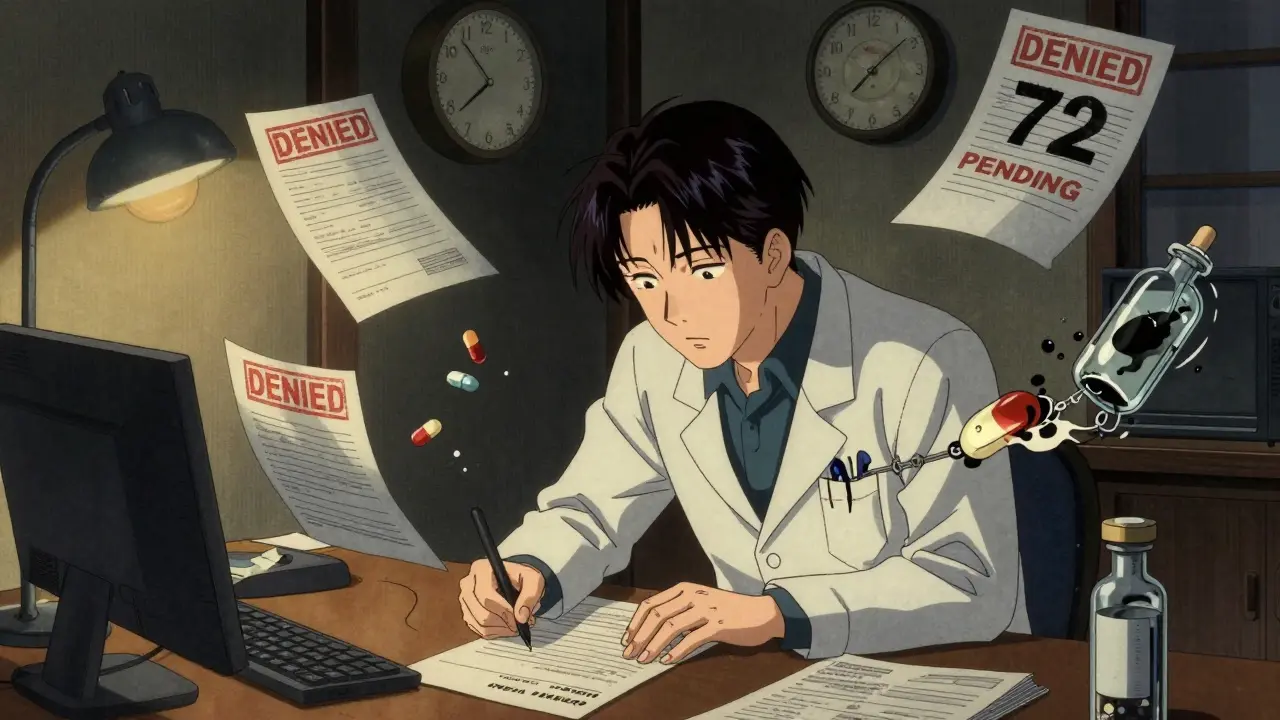
Step therapy doesn’t just delay treatment-it can cause irreversible harm. For conditions like multiple sclerosis, Crohn’s disease, or severe depression, waiting weeks or months for approval can mean losing mobility, function, or even quality of life. The American College of Rheumatology openly opposes step therapy because it puts patients at risk.And the appeals process? It’s slow. Insurers often take four to eight weeks to review an exception request. Blue Cross Blue Shield of Michigan says their standard review takes 72 business hours-but that’s not always the case. Some patients wait a full month just to get a response. The American College of Rheumatology estimates doctors spend nearly 18 hours a week just filling out paperwork for prior authorizations and step therapy exceptions. That’s time they could be spending with patients.
Even worse: if you switch jobs or insurance plans, you often have to restart the entire step therapy process-even if you’ve been on the same medication for years. A patient who’s been stable on a biologic for three years might be forced to try three cheaper drugs again. That’s not medical logic. That’s bureaucracy.
When Exceptions Are Allowed
Thankfully, step therapy isn’t absolute. Federal and state laws require insurers to allow exceptions under certain conditions. The Safe Step Act, introduced multiple times since 2017, outlines five clear cases where insurers must bypass the step process:- The required drug was tried before and didn’t work
- The required drug would cause severe or irreversible harm
- The required drug is contraindicated based on your medical history
- The required drug would prevent you from doing daily activities
- You’re already stable on your current medication and it was previously covered
These exceptions aren’t optional. If your doctor submits documentation showing one of these applies, the insurer must approve the request. But getting that documentation accepted? That’s another battle. Clinicians need to provide lab results, past treatment records, and sometimes even letters of medical necessity. It’s not a quick call. It’s a paper trail.
State vs. Federal Rules
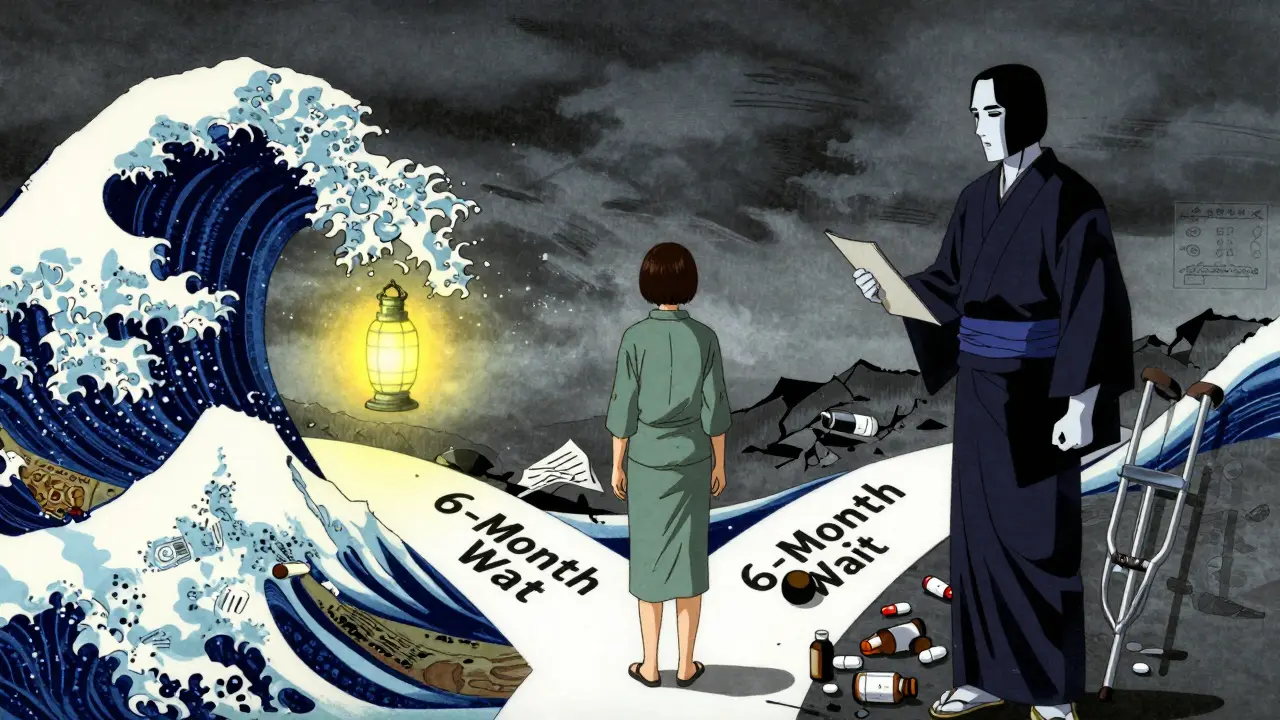
Here’s where it gets messy. As of 2022, 29 states passed laws requiring insurers to offer step therapy exceptions. But here’s the catch: those laws only apply to fully-insured plans. That means if your employer pays for your insurance directly (a self-insured plan), state laws don’t touch it. And guess what? About 61% of Americans are covered by self-insured plans-regulated only by the federal Department of Labor.That creates a huge loophole. You could live in a state with strong protections, but if your employer is self-insured, you get none of them. The Safe Step Act, reintroduced in 2021, aimed to fix this by extending the same protections to self-insured plans under ERISA. But it hasn’t passed yet. So right now, your access to timely care depends on where you live-and who your employer is.
What Patients Can Do
If you’re caught in step therapy:- Ask your doctor to file an exception request immediately. Don’t wait. Use the five criteria above as a checklist.
- Get everything in writing. Emails, letters, prescriptions. Keep copies.
- Call your insurer’s member services. Ask for a case manager. Some insurers assign one to complex cases.
- Check if your drug manufacturer offers patient assistance. Nearly 80% of big pharma companies provide co-pay cards or free trials that can help you bypass step therapy temporarily.
- If you’re denied, appeal. Most insurers have a formal appeals process. Don’t give up.
Some patients do find success. A 2023 GoodRx survey found 17% of people ended up managing their condition just fine on the generic drug they were required to try first. But that’s not the norm. For most, it’s a gamble with their health.
The Future of Step Therapy
Industry analysts predict step therapy will cover 55% of specialty drug prescriptions by 2025. That’s up from 40% today. More insurers are adding it. More states are trying to regulate it. But without federal action, the system will stay broken.The goal isn’t to eliminate step therapy entirely. It can work when used fairly. But right now, it’s often used as a cost-cutting tool that ignores patient outcomes. Until insurers are required to respond to exceptions within days-not weeks-and until self-insured plans are held to the same rules as fully-insured ones, patients will keep paying the price-in pain, in time, and in health.
What is step therapy?
Step therapy is an insurance rule that requires patients to try one or more lower-cost medications (often generics) before the insurer will cover a more expensive drug prescribed by their doctor. It’s also called a "fail-first" policy because you must prove the cheaper option doesn’t work before moving up.
Why do insurers require step therapy?
Insurers use step therapy to control prescription drug costs. By pushing patients toward cheaper, generic drugs first, they reduce spending. Studies show it can cut drug costs by 5% to 15% in some cases. But critics argue it delays effective treatment and harms patient outcomes.
Can I skip step therapy if my doctor says I need the original drug?
Yes, but only if you qualify for an exception. Insurers must grant exceptions if: the required drug was tried before and failed, it’s contraindicated for you, it would cause serious harm, it would prevent daily activities, or you’re already stable on your current medication. Your doctor must submit medical records to support the request.
How long does it take to get an exception approved?
Approval times vary. Some insurers promise 72 business hours for standard requests and 24 hours for urgent cases. But in practice, many patients wait four to eight weeks. The Arthritis Foundation found 73% of patients took one to three months to get an exception approved.
Are step therapy rules the same in every state?
No. Twenty-nine states have laws requiring insurers to allow exceptions, but these only apply to fully-insured plans. Self-insured plans (which cover about 61% of Americans) are regulated federally and aren’t subject to state laws. So your protections depend on how your insurance is structured, not where you live.
What if I switch insurance plans? Do I have to restart step therapy?
Yes. Even if you’ve been on the same medication for years, switching plans often means restarting the step therapy process. This can cause dangerous treatment gaps, especially for chronic conditions. Some insurers are starting to recognize this issue, but there’s no federal rule requiring them to honor prior coverage.
Can pharmaceutical companies help me avoid step therapy?
Yes. About 78% of major drug manufacturers offer patient assistance programs, including co-pay cards, free trials, or discount coupons. These can help you get your medication while you wait for insurance approval-or sometimes even bypass step therapy entirely. Ask your pharmacist or the drug company’s patient support line.







Prathamesh Ghodke
19 Mar, 2026
Man, this step therapy nonsense is wild. I had a cousin in Mumbai who got stuck on this for six months trying to get his RA meds approved. He ended up in the hospital because they made him try ibuprofen first. Like, bro, it’s not a video game where you level up to unlock the good gear. This is someone’s body we’re talking about.
And don’t even get me started on the paperwork. My uncle’s a doctor in Pune-he spends half his day filling out forms instead of seeing patients. He told me he once had to fax a letter to an insurer in Texas because the patient moved from New York. No joke. The system is broken.
But hey, at least we’re lucky here. In India, we don’t have this crap. You go to a clinic, get a script, and you’re done. No bureaucracy. Just care. Maybe we should export that model instead of importing American insurance nonsense.
Lauren Volpi
20 Mar, 2026
Oh wow, another sob story about rich Americans who can’t afford their $10,000-a-month drugs. Newsflash: generics work for 90% of people. If your ‘special’ biologic didn’t work after trying a $5 pill, maybe you’re just not that special.
Also, ‘irreversible joint damage’? Sounds like you didn’t go to the gym. Try lifting weights instead of crying to Big Pharma. This isn’t healthcare-it’s entitlement.
Shameer Ahammad
21 Mar, 2026
It is, without a doubt, a profound and deeply troubling systemic failure-a grotesque perversion of medical ethics, wherein profit-driven corporate entities, shielded by regulatory loopholes and legal technicalities, deliberately impose arbitrary, medically unsound barriers upon vulnerable individuals, thereby violating the fundamental principle of patient autonomy.
Furthermore, the fact that self-insured plans-constituting over sixty-one percent of the U.S. population-are exempt from state-level protections constitutes a glaring, indefensible, and constitutionally suspect jurisdictional anomaly.
And yet, no one dares to speak truth to power. The silence is deafening. The complicity is criminal.
Alexander Pitt
22 Mar, 2026
Step therapy isn’t evil. It’s just poorly implemented. The real problem is the delays. If insurers approved exceptions in 72 hours like they claim, nobody would care. But they don’t. They drag it out for months.
And the appeals process? It’s a maze. Doctors don’t have time to fight it. Patients get tired and give up. That’s the issue-not the concept, but the execution.
Fix the timeline. Enforce deadlines. Make it automatic when a doctor says ‘no’ to the first drug. Done.
Manish Singh
23 Mar, 2026
I live in India, and I’ve seen how healthcare works here-no insurance middlemen, no step therapy, no forms. You walk in, doctor says ‘take this,’ you pay, you leave. Simple.
But I get why Americans are stuck with this mess. It’s not just about money-it’s about control. Insurance companies don’t care if you’re in pain. They care if your claim goes through their system.
And yeah, switching jobs and restarting the whole process? That’s insanity. If I moved from Delhi to Bangalore and had to re-prove I needed my asthma inhaler, I’d move back. People should be outraged.
Nilesh Khedekar
24 Mar, 2026
you know what this really is? a big pharma vs insurance war and we’re the pawns. they dont want you on the good drug because theyre scared youll find out the generic is just as good… but wait-what if the generic ISN’T as good? what if its just a placebo with a different label? what if the big pharma companies are secretly paying insurers to make you wait? i mean, think about it… why else would they make you suffer for 6 months? its not about cost… its about control.
and dont tell me the exceptions are real. ive heard of people submitting 17 pages of docs and still getting denied. someone’s got a spreadsheet somewhere that says ‘deny unless you have a death certificate’.
Robin Hall
25 Mar, 2026
The systemic inefficiencies inherent in the current step therapy framework represent a fundamental misalignment between fiscal imperatives and clinical outcomes. The reliance upon arbitrary, protocol-driven decision-making, devoid of individualized clinical nuance, is not only statistically unsound but ethically indefensible.
Furthermore, the jurisdictional dissonance between fully-insured and self-insured plans constitutes a regulatory arbitrage opportunity that systematically disadvantages the American working class. This is not healthcare policy. This is corporate legal engineering.
Until ERISA is amended to align with state-level protections, this will remain a moral crisis.
jared baker
27 Mar, 2026
My sister had MS. They made her try three generics before letting her on her real med. Took four months. She lost feeling in her legs. She’s fine now, but she’ll never get that time back. Just say no to step therapy. Let doctors do their jobs.
Michelle Jackson
29 Mar, 2026
okay but like… why are we even surprised? insurance companies are literally designed to say no. if they said yes to everything, they’d go bankrupt. so of course they make you jump through hoops. it’s not personal-it’s business.
and don’t get me started on the ‘patient assistance’ programs. those are just PR stunts. they’ll give you a free month, then charge you $2000 after. it’s a trap.
we need single-payer. end of story.
Suchi G.
29 Mar, 2026
I’ve been living with lupus for 12 years, and step therapy has been the single most emotionally draining part of my journey. I remember sitting in a doctor’s office crying because I had to wait three months to get my drug approved. My hands were swelling. I couldn’t hold my daughter. I kept thinking-what if I can’t hold her forever? What if this delay is the thing that changes everything?
And then, when the approval finally came, I had to fight to get the pharmacy to fill it because they said ‘we don’t carry it yet.’ So I drove 90 miles to a different pharmacy. I was in pain. I was exhausted. I was alone.
And now? I’m fine. But I’m not okay. Because I know what’s out there. I know how many people are still stuck in that same loop. And nobody’s talking about the mental toll. The anxiety. The guilt. The fear that you’re a burden. That you’re not sick enough to matter.
This isn’t about cost. It’s about humanity.
becca roberts
30 Mar, 2026
So let me get this straight-you’re telling me that in 2025, we’re still making people prove they’re sick enough to get better? That’s not healthcare. That’s performance art.
And don’t even get me started on the ‘exceptions.’ It’s like the insurance companies wrote a rulebook for a game called ‘Catch Me If You Can: The Paperwork Edition.’
Meanwhile, Big Pharma is out here making billions selling the same drugs they told insurers to block. It’s like they’re playing both sides. I’m not mad. I’m just… disappointed.
Someone needs to write a Netflix docu-series about this. I’d binge it. With popcorn. And a lawyer.
Prathamesh Ghodke
31 Mar, 2026
Actually, I just got an email from my cousin’s doctor. He got approved last week. Took five months. But here’s the kicker-he didn’t appeal. The insurer just gave in because they got sued by another patient in Ohio. So yeah, the system’s rigged… but sometimes, lawsuits work.
Maybe we need more lawsuits. Not more paperwork.