
Imagine flying from New York to Toronto and discovering that the exact same medication you take every morning is 80% cheaper across the border. Or perhaps you're traveling in Europe and find that your usual generic prescription isn't available, but the brand-name version is the only option. It feels random, but it isn't. The world of generic drug availability is a fragmented map of patent laws, regulatory hurdles, and cultural biases. While the goal of generics is to lower costs and increase access, where you live determines whether you actually get those savings.
| Region/Country | Generic Prescription Rate | Market Characteristics | Price Level |
|---|---|---|---|
| United States | Over 90% | High volume, low price competition | Highest globally |
| United Kingdom | ~83% | Strong mandatory substitution | Low to Moderate |
| Switzerland | ~17% | High brand preference, slow uptake | Very High |
| India | High | Global production hub | Lowest |
The Great Divide in Prescription Rates
Why does someone in London have an 83% chance of getting a generic, while someone in Switzerland only has a 17% chance? It usually comes down to how the government handles drug substitution. In the UK and the Netherlands, mandatory substitution policies push generic uptake to 60-70% within a year of a patent expiring. In contrast, countries like Italy or Switzerland often take three to five years to reach those same levels because physicians and patients stick to the names they know.
The United States is a bit of a paradox. It has one of the highest generic utilization rates in the world-often exceeding 90% for off-patent drugs-yet it also has some of the highest prices. You'd think more generics would mean lower prices everywhere, but the U.S. market often suffers from "irrational pricing." This means that even for drugs that have been off-patent for decades, you might see sudden price spikes despite having multiple manufacturers in the mix.
The Role of the Global Pharmacy: India and China
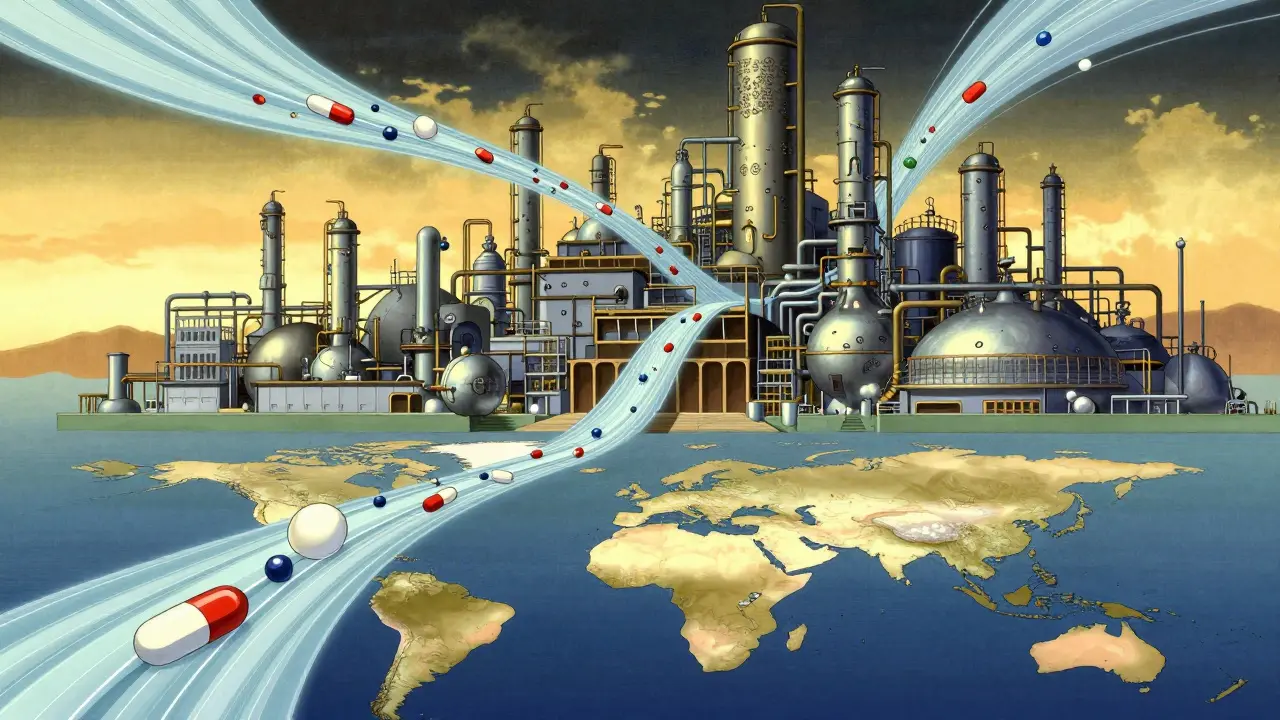
If you look at the back of your pill bottle, there is a high chance the active ingredients came from India. India is essentially the world's pharmacy, producing about 20% of the global generic volume. In fact, about 40% of the generics consumed in the U.S. are made there. This dominance is backed by over 750 FDA-approved facilities.
However, this reliance creates a quality gamble. A study from Ohio State University highlighted a worrying trend: generics made in India were associated with 54% higher rates of severe adverse events-like hospitalizations or disability-compared to identical products made in the U.S. This is particularly true for older, cheap drugs where the pressure to cut costs is highest. Meanwhile, China is catching up fast. Their number of FDA-approved facilities jumped from just 12 in 2010 to 187 by 2023, shifting the balance of global supply.
What Makes a "Generic" Actually Generic?
To be sold as a generic, a drug must prove bioequivalence. This means the drug must deliver the active ingredient into the bloodstream at a rate and extent similar to the brand-name version. In the U.S., the Food and Drug Administration (FDA) requires the generic to fall within 80-125% of the reference product's pharmacokinetic parameters.
But "similar" doesn't mean "identical." While the active ingredient is the same, the inactive ingredients-called excipients-can vary. This is why some people report different side effects when switching brands. For example, patients using Cipla generics in the U.S. have reported different side effect profiles compared to U.S.-manufactured versions, even though the primary molecule was the same. If you're traveling, this is why a Canadian generic might feel different than a U.S. one; it could be a different salt form or a different filler causing a reaction.
The Price War and the Danger of "Too Cheap"
Price differences across borders are staggering. For the same generic molecule, prices can differ by over 600% between countries. India's prices average 63% lower than those in Belgium. This gap fuels "parallel trade," where drugs are bought in low-price countries and sold in high-price markets. While this sounds like a win for consumers, it can lead to instability.
When competition becomes too intense, profit margins vanish. Some experts argue that this "race to the bottom" is actually dangerous. If a manufacturer can't make a profit, they might stop producing the drug entirely or cut corners on quality. This leads to the generic drug shortages we've seen recently. In 2023, the FDA documented 147 generic shortages, and nearly 70% were due to quality issues at single-source facilities in India and China. When one factory fails, the whole world feels it.

The Next Frontier: Biosimilars and Evergreening
The industry is now moving toward biosimilars. Unlike simple chemical generics, biosimilars are copies of complex biological medicines. They are expected to be 50% cheaper than the brands they replace, but they aren't as easy to swap. Because they are grown in living cells, they aren't identical copies, meaning the regulatory hurdles for "interchangeability" are much higher.
At the same time, big pharma companies use a tactic called "evergreening." This is where they make a tiny change to a drug's formula-perhaps changing it from a tablet to a capsule-and file a new patent. This can block generics from entering the market for years. Between 2015 and 2022, over 1,200 supplemental patents were filed for just 12 of the top-selling drugs to keep the competition away.
Practical Tips for Navigating Global Generics
If you are managing a chronic condition and traveling or sourcing meds globally, keep these rules of thumb in mind:
- Check the Active Ingredient: Always look for the generic name (e.g., Metformin) rather than the brand name.
- Verify the Manufacturer: If you're sourcing from an online pharmacy, check if the facility is FDA or EMA approved.
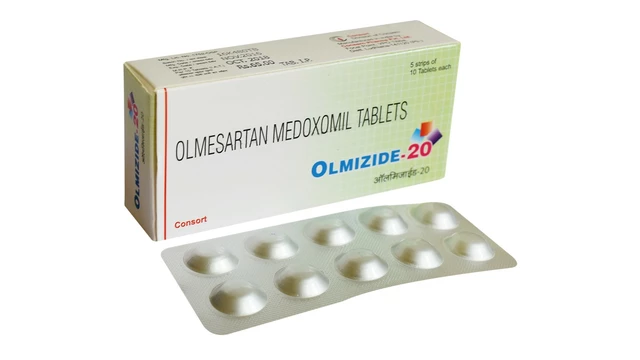
- Document Your Version: Keep a photo of your medication's packaging. This helps a foreign pharmacist match the exact salt form and strength.
- Be Aware of "Bio-Similar" Differences: If you switch to a biosimilar, monitor your reaction more closely than you would with a simple generic.
Are generic drugs from India lower quality than U.S. ones?
Not necessarily, but there are documented risks. While most Indian generics meet global standards, some studies have shown higher rates of severe adverse events for certain older drugs manufactured in India due to intense cost pressures and differences in inspection protocols (such as pre-announced versus unannounced inspections).
Why is the same generic drug so much cheaper in Canada than in the U.S.?
This is primarily due to different pricing regulations and government negotiations. Canada often has more centralized controls on pharmaceutical pricing, whereas the U.S. system relies more on market negotiations and a complex web of pharmacy benefit managers, which can keep retail prices higher.
What is "evergreening" in the pharmaceutical industry?
Evergreening is a strategy where brand-name companies file for new patents on slight modifications of an existing drug (like a new dosage form or a slightly different chemical salt). This extends their monopoly and delays the entry of cheaper generic versions into the market.
What is the difference between a generic and a biosimilar?
Generics are exact chemical copies of small-molecule drugs. Biosimilars are "highly similar" versions of complex, large-molecule biological drugs. Because biologics are made from living organisms, they can't be perfectly copied, meaning biosimilars require more rigorous testing to prove they work the same way as the original.
Can I trust a generic drug if it's significantly cheaper than the brand?
Yes, provided it is approved by a reputable regulatory body like the FDA or EMA. The low price is usually due to the fact that the generic manufacturer didn't have to pay for the original research and development (R&D) and clinical trials, not because they used inferior ingredients.





Write a comment