

When someone suddenly can't speak clearly, one side of their face droops, or their arm goes numb, most people think stroke. But what if those symptoms disappear in 10 minutes? Many assume it’s nothing-maybe they slept funny, or it was just a passing dizzy spell. That’s dangerous thinking. A transient ischemic attack, or TIA, looks just like a stroke… and then it vanishes. But it’s not a warning. It’s a signal. A loud, urgent one. And ignoring it could cost you your life-or your independence.
What Exactly Is a TIA?
A TIA, sometimes wrongly called a "mini-stroke," is a temporary blockage of blood flow to part of the brain. Unlike a stroke, it doesn’t leave permanent damage. But here’s the catch: the old idea that a TIA lasts less than 24 hours is outdated. Since 2009, doctors have shifted focus from time to tissue. If there’s no brain damage on an MRI, it’s a TIA. If there is-even if symptoms lasted only 5 minutes-it’s a stroke. That’s right. Some people who think they had a TIA actually had a minor stroke. About 35% of patients who come in with TIA-like symptoms turn out to have small areas of dead brain tissue when scanned. That’s not a warning. That’s already damage.How Do You Tell the Difference Between a TIA and a Stroke?
The symptoms are identical. Both can cause:- Sudden numbness or weakness in the face, arm, or leg-especially on one side
- Sudden confusion, trouble speaking, or difficulty understanding speech
- Sudden trouble seeing in one or both eyes
- Sudden dizziness, loss of balance, or lack of coordination
- Sudden severe headache with no known cause
Why a TIA Is More Dangerous Than It Looks
A TIA isn’t a dry run. It’s a red alert. One in five people who have a TIA will have a full stroke within 90 days. And the biggest risk? The first 48 hours. Up to 5% of people will have a stroke within two days. That’s higher than most people realize. The ABCD2 score-a simple tool doctors use-helps predict that risk. It looks at:- Age: 60 or older = 1 point
- Blood pressure: 140/90 or higher = 1 point
- Clinical features: Weakness on one side = 2 points; speech trouble without weakness = 1 point
- Duration: Symptoms over 60 minutes = 2 points; 10 to 59 minutes = 1 point
- Diabetes: Present = 1 point
What Happens When You Go to the Hospital?
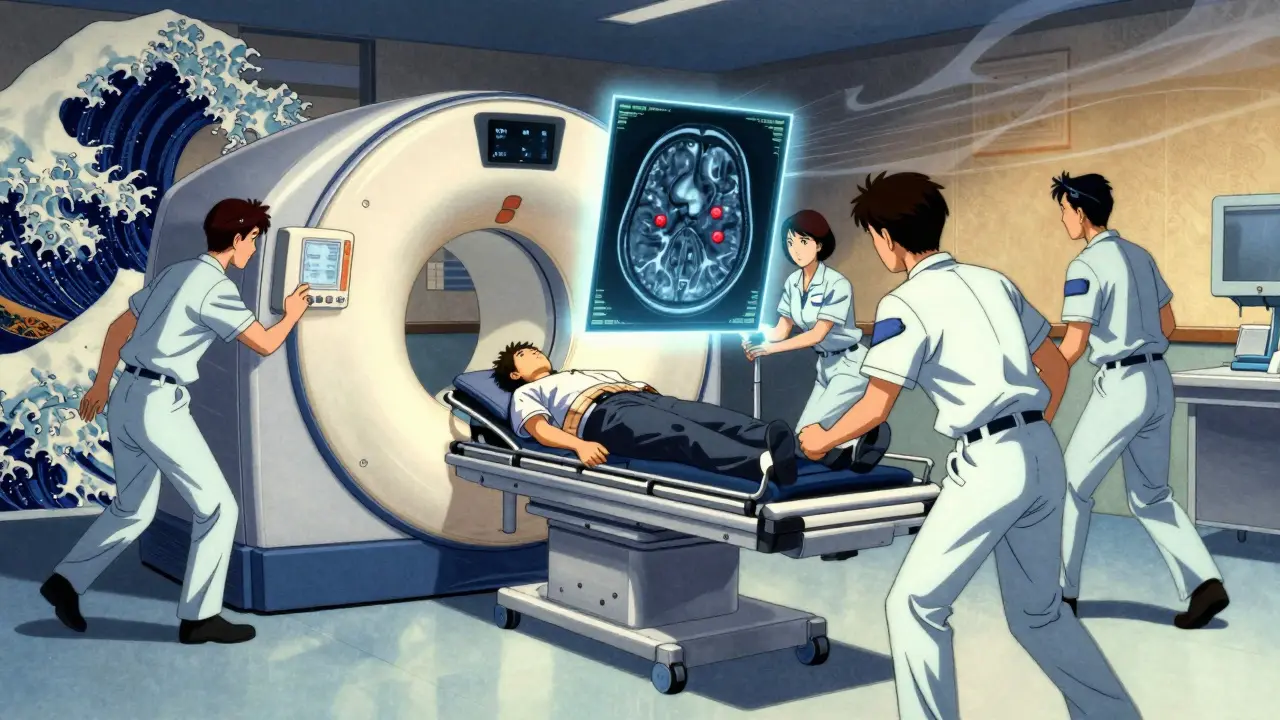
If you or someone else has TIA symptoms-even if they’re gone-you need to call 911. Not your neighbor. Not your doctor’s office. 911. Emergency teams are trained to act fast. At the hospital, they’ll do two things immediately:- Run a non-contrast CT scan to rule out bleeding in the brain.
- Get you on an MRI with diffusion-weighted imaging within 24 hours. This is the gold standard. It can spot tiny areas of brain injury that a CT scan misses.
What Treatment Happens Right Away?
Time is brain. And treatment starts the moment you’re assessed. For high-risk TIA patients (ABCD2 score ≥4), guidelines say to start treatment within 24 hours. That means:- Aspirin: 325 mg right away. This cuts your stroke risk by 60% in the first few days.
- Dual antiplatelet therapy: Aspirin plus clopidogrel for 21 to 30 days. This combo reduces stroke risk by 80% compared to aspirin alone.
- High-intensity statin: Atorvastatin 80 mg daily. Lowers cholesterol fast and stabilizes plaque in your arteries.
- Blood pressure control: Goal under 140/90 mmHg. Even if you’re not hypertensive, lowering it helps prevent another event.
What You Should Do Right Now
If you’ve ever had symptoms like this-even once-write down what happened. When? How long? What did you feel? Tell your doctor. If you’re over 50, have high blood pressure, diabetes, or smoke, you’re at higher risk. Get checked. Don’t wait for symptoms to return. Use the BE FAST checklist to spot trouble:- Balance: Sudden loss of balance or coordination
- Eyes: Sudden vision changes
- Face: One side drooping
- Arm: One arm drifting down when raised
- Speech: Slurred or strange speech
- Time: Call 911 immediately-don’t wait

The Bigger Picture: Why This Matters
About 240,000 to 500,000 people in the U.S. have a TIA every year. Only 15 to 30% go to the hospital right away. That’s a huge gap. Hospitals that treat TIA as an emergency-like those with dedicated TIA clinics-see stroke rates drop by more than 80%. And it’s not just about saving lives. A stroke costs over $21,000 on average. A TIA evaluation? Around $2,850. Prevention saves money. But more than that, it saves independence. New tools are coming. Blood tests for GFAP, a protein released by damaged brain cells, could soon tell if there’s brain injury in under 15 minutes. AI tools are getting better at predicting who’s at highest risk. But none of that matters if you don’t act.What Happens After the Emergency?
Once you’re stable, you’ll need ongoing care. That means:- Regular follow-ups with a neurologist or stroke specialist
- Lifestyle changes: quit smoking, eat less salt, move more
- Managing diabetes, high blood pressure, and cholesterol
- Long-term aspirin or other antiplatelet meds
- Checking for atrial fibrillation with a heart monitor
Can a TIA happen without symptoms?
No. By definition, a TIA causes noticeable neurological symptoms-like weakness, speech trouble, or vision loss. But some people mistake mild dizziness or a brief headache for something else. If you’re unsure, get checked. Silent brain injuries can still happen, especially with advanced imaging.
Is a TIA less serious than a stroke?
No. A TIA is not "less serious." It’s a major warning that your brain is at risk. Many people who have a TIA will have a stroke within days or weeks. The fact that symptoms go away doesn’t mean the danger is gone. In fact, the brain may already have small injuries that aren’t visible on a regular scan.
Should I still call 911 if the symptoms are gone?
Yes. Always. If you had any stroke-like symptoms-even if they lasted only 10 minutes and are now gone-you need emergency evaluation. Delaying care increases your stroke risk by 3 to 5 times. Emergency teams can start treatment immediately and get you scanned before it’s too late.
Can I just take aspirin at home and wait?
No. Aspirin helps, but it’s not a substitute for medical evaluation. You could have a different condition-like a brain tumor, seizure, or migraine-that mimics a TIA. Only a doctor can confirm what happened and rule out other causes. Plus, you might need more than aspirin-like blood thinners, statins, or blood pressure control.
How soon after a TIA should I see a specialist?
Within 24 hours. The sooner you’re evaluated, the lower your risk of a full stroke. Hospitals with dedicated TIA programs aim to see patients the same day. If you’re high risk (ABCD2 score ≥4), you should be seen within 12 hours. Don’t wait for a doctor’s appointment next week. Call your ER or a stroke center directly.
Can lifestyle changes prevent another TIA or stroke?
Yes, and they’re essential. Quitting smoking, eating a low-sodium diet, exercising regularly, and controlling blood pressure and cholesterol can cut your risk by up to 80%. Medication alone isn’t enough. You need both: drugs to manage your condition, and habits to protect your brain long-term.





Michael Burgess
2 Jan, 2026
Just had a friend go through this last year - thought it was a migraine, stayed home, watched Netflix. Next morning, she couldn’t lift her coffee cup. Turned out it was a TIA that lasted 7 minutes. MRI showed three tiny lesions. Docs said if she’d gone in right away, she might’ve avoided the mild aphasia she still deals with. Don’t be like my friend. Call 911. Even if you feel fine now.
Also - aspirin at home? Nah. You don’t know if it’s a TIA, a tumor, or just a really bad sinus headache. Let the pros sort it out.
Palesa Makuru
3 Jan, 2026
Wow. So you’re telling me I shouldn’t just ‘wait and see’ when my grandma says she got dizzy for a minute? Like, what, she’s supposed to ruin her whole day because her vision flickered? I mean, come on. Not everyone can drop everything and race to the ER. Some of us have jobs. Kids. Life.
Shruti Badhwar
3 Jan, 2026
As a neurology nurse in Mumbai, I’ve seen this too many times. Families wait because ‘it went away’ - then the patient comes back in a week, paralyzed. TIA isn’t a warning. It’s the alarm clock ringing and you hitting snooze for the 10th time. The stats don’t lie: 1 in 5 have a stroke within 90 days. If you ignore this, you’re gambling with your brain. No one deserves that.
Brittany Wallace
3 Jan, 2026
It’s wild how we treat our bodies like cars - ‘Oh, the check engine light went off, so it’s fine!’ But your brain? It’s not a Honda Civic. It’s the whole damn operating system. And when it flickers? You don’t reboot. You call the mechanic. Immediately.
Also, the BE FAST checklist? Genius. I printed it and taped it to my fridge. My mom’s got AFib. She gets it now. 😊
Vincent Sunio
4 Jan, 2026
While the intent of this post is commendable, the oversimplification of clinical criteria is alarming. The 2009 shift from time-based to tissue-based definition is not universally accepted in all neurology circles. Some institutions still use the 24-hour window as a pragmatic triage tool, especially in resource-limited settings. Furthermore, the assertion that ‘all TIAs are strokes’ is a semantic overreach - it confuses pathophysiology with taxonomy. A TIA is still a transient phenomenon. To equate it with a completed infarct is misleading and potentially causes unnecessary panic.
Tru Vista
5 Jan, 2026
aspirin 325mg? lol i took one once and got a headache. maybe i should’ve gone to the er. but i didn’t. so… yeah. 🤷♀️
Neela Sharma
6 Jan, 2026
My uncle had a TIA while cooking chai. Said his hand went numb, words slipped out like broken beads. He laughed it off. Said ‘beta, I’m fine now.’ Three days later, he couldn’t walk. Now he uses a cane. Don’t wait for the big crash. The little flicker? That’s the first crack in the dam.
Call 911. Not your cousin. Not your neighbor. 911. That’s the only number that matters.
innocent massawe
6 Jan, 2026
This is so important in Nigeria too. People think stroke is for old rich people. But my cousin, 38, had TIA after all-night gaming. No symptoms? He thought. But MRI showed damage. Now he’s on meds, no more energy drinks. Your brain doesn’t care if you’re young or poor. It just wants blood.
Share this. In Lagos, no one talks about this.
veronica guillen giles
8 Jan, 2026
Oh wow. So if I ignore a 5-minute tingling arm, I’m a monster? Thanks for the guilt trip, Dr. Doomsday. I’m sure my 20-minute nap after work is just a prelude to brain death. 😏
Hank Pannell
9 Jan, 2026
There’s a deeper epistemological tension here: if a neurological event resolves without radiographic evidence of infarction, can we truly say it was a cerebrovascular incident? Or is it a transient dysfunction of neurovascular coupling - perhaps endothelial microspasm, or even a cortical spreading depression akin to migraine aura? The current diagnostic framework is pragmatic, not ontological. We label it TIA because we lack the biomarkers to distinguish it from other transient cortical phenomena. Until GFAP becomes point-of-care standard, we’re operating on probabilistic inference, not certainty. That’s not weakness - it’s science in progress.
Sarah Little
9 Jan, 2026
Interesting that they mention GFAP but don’t cite the 2023 JAMA study showing 32% false positives in non-stroke patients with migraines. Also, dual antiplatelet therapy increases GI bleed risk by 1.8x - but no one talks about that. Just give aspirin and call it a day. Classic medical reductionism.
erica yabut
10 Jan, 2026
Of course you should call 911. But let’s be honest - most ERs in the U.S. are overcrowded, understaffed, and treat TIA like a nuisance. You’ll wait 6 hours, get a CT that’s ‘normal,’ and be sent home with a pamphlet. The real problem isn’t patient ignorance - it’s a broken system that only prioritizes acute intervention, not prevention. And yes, I’ve been there. Twice.
Liam Tanner
11 Jan, 2026
I work in a rural clinic. We don’t have MRIs. We don’t have neurologists on call. But we do have aspirin. And we do have people who know their neighbors. If someone says, ‘My arm went numb for a minute,’ we give them aspirin, tell them to drink water, and get them to the county hospital within 24 hours. This post is great for cities. But in places like mine? We do the best we can with what we have. And that’s still better than doing nothing.
Michael Burgess
11 Jan, 2026
^ This. Rural access is the silent killer here. My cousin in West Virginia waited 72 hours because the nearest ER was 90 minutes away. By then, she had a stroke. We need mobile stroke units. We need tele-neurology. We need policy change. Not just awareness. The system’s failing people who live off the highway.