

Swimmer’s ear isn’t just a nuisance-it’s a painful, common infection that can turn a summer swim into days of discomfort. Medically called otitis externa, it’s an infection of the outer ear canal, the tube that runs from your eardrum to the outside of your head. It’s not caused by water in the ear alone, but by what happens after: moisture stays trapped, creating a warm, dark breeding ground for bacteria. About 98% of cases are from bacteria like Pseudomonas aeruginosa or Staphylococcus aureus. And while it’s called ‘swimmer’s ear,’ you don’t have to be a competitive athlete to get it. Just one extra-long shower, a humid day, or even a cotton swab too far in can trigger it.
What Does Swimmer’s Ear Actually Feel Like?
If you’ve had it, you know the pain isn’t mild. It’s sharp, deep, and gets worse when you tug on your earlobe or press on the bump in front of your ear (the tragus). That’s the tragus test-doctors use it because if it hurts when you press there, it’s almost certainly otitis externa. Studies show this test catches 94% of cases, while misdiagnosing it as a middle ear infection happens in 1 in 4 cases.
You’ll also notice drainage. At first, it’s clear or watery. Within a day or two, it turns yellow or green. Your ear might feel full, and your hearing can drop by 20 to 30 decibels-like someone turned down the volume. You might not realize it, but you’re asking people to repeat themselves more often. And if you’re a parent, you’ll notice your child pulling at their ear, crying when lying on that side, or refusing to swim.
Children between 7 and 12 make up 43% of cases. Young adults 15 to 25 are next, with men more likely to be affected than women. But anyone who spends time in water-whether it’s swimming, surfing, or even washing their hair with their head tilted-is at risk.
Why Do Some People Keep Getting It?
Recurrent swimmer’s ear isn’t bad luck. It’s usually a pattern of habits that keep the ear canal moist or damaged. The biggest culprit? Cotton swabs. About 65% of cases caused by injury come from people poking around inside their ears trying to ‘clean’ them. That tiny scratch opens the door for bacteria. Even scratching with a fingernail or using earbuds too often can do the same thing.
Another major factor: water exposure. Swimming more than four days a week raises your risk by more than seven times. But it’s not just pools. Lakes, oceans, and even hot tubs carry the same risk. The problem isn’t the water itself-it’s what happens after. If water sits in your ear for more than two minutes, the chances of infection jump.
People with eczema or psoriasis on their scalp or ears are also more vulnerable. Their skin is already fragile and prone to cracking, making it easier for bacteria to sneak in. And if you’ve had one episode, you’re more likely to get another-especially if you don’t change your habits. Studies show 87% of people with three or more episodes in a year still insert objects into their ears despite being told not to.
How to Treat Swimmer’s Ear: What Actually Works
Good news: otitis externa responds well to treatment-if you do it right. First-line treatment is antibiotic ear drops. The most effective are fluoroquinolone-based, like Cipro HC (ciprofloxacin and hydrocortisone). Used as 10 drops twice a day for seven days, they cure 92% of cases. That’s far better than older drops like neomycin-polymyxin, which work fine for simple cases but cost less ($18.75 vs. $24.25 per course) and have only a 1.2% higher failure rate in non-pseudomonal infections.
For the 2% of cases caused by fungus, clotrimazole drops are the go-to. Five drops twice daily for two weeks. It’s slower, but it clears the infection without harming the ear’s natural balance.
Pain relief is just as important. Mild pain? Acetaminophen at 15 mg per kg of body weight every six hours works well. But if it’s bad-68% of patients feel this level-you’ll need something stronger. Oxycodone at 0.15 mg per kg every four to six hours brings relief fast. Don’t wait until you can’t sleep. Pain control helps you rest, which helps your body heal.
But here’s the catch: treatment fails 40% more often if your ear stays wet. A 2021 study showed 63% of people who didn’t keep their ears dry during treatment had a relapse. That means no swimming, no showers without protection, and no letting water linger after washing your hair.
How to Use Ear Drops the Right Way
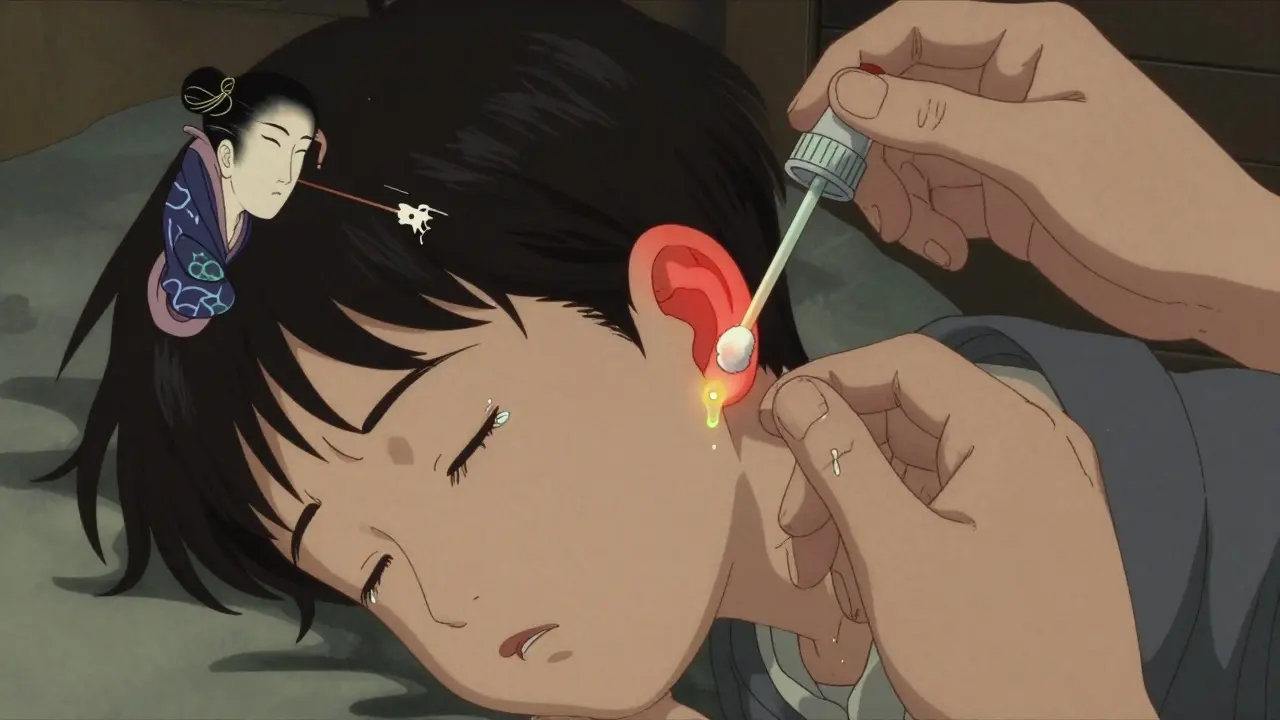
Even the best drops won’t work if you don’t use them correctly. Most people get it wrong. Here’s how to do it right:
- Warm the bottle in your hand for a minute. Cold drops can make you dizzy.
- For adults: pull the top of your ear (pinna) up and back. For kids under 3: pull down and back. This straightens the ear canal.
- Hold the dropper above your ear. Don’t touch it to the skin. Squeeze in the right number of drops.
- Stay on your side for five minutes. Let gravity help the medicine sink in. If you stand up too soon, most of it drains out.
- Use a calibrated 1 mL dropper. Many over-the-counter bottles aren’t marked properly-this reduces dosage errors from 42% to just 8%.
People who’ve had it before get it right 92% of the time. First-timers? Only 38%. That’s why clinics that give you a short video-like Mayo Clinic’s 12-minute guide-see better results. If your doctor just hands you the bottle and says ‘use twice a day,’ ask for a demo.
Prevention: The Real Game-Changer
Treatment works. But prevention works better. And it’s cheaper. Here’s what actually reduces your risk:
- Alcohol-vinegar rinse: Mix 70% isopropyl alcohol with 30% white vinegar. Put 3-5 drops in each ear after swimming or showering. Let it sit for 30 seconds, then tilt your head to drain. This cuts infection risk by 72%, according to a study of 1,200 swimmers.
- Custom silicone earplugs: These cost $45-$120 but block 68% of water from entering the canal. Foam plugs? Only 42% effective. If you swim often, the custom ones pay for themselves in avoided doctor visits.
- Dry your ears properly: After water exposure, tilt your head and gently pull your earlobe to help water drain. Use a hairdryer on the coolest, lowest setting, held 12 inches away, for 30 seconds. A top-rated Reddit post from a swimmer who avoided recurrence for four years says this was the key.
- Avoid the cotton swab: This can’t be repeated enough. Your ear cleans itself. Pushing anything in just pushes wax deeper and scrapes the skin. If you feel blocked, see a professional for safe cleaning.
- Limit water exposure: If you’re not swimming, keep your ears dry. Showering with your head tilted? Use cotton balls coated in petroleum jelly to seal the opening. One patient said this helped them avoid missing two workdays after being told they couldn’t shower for a week.

What’s New in Treatment and Prevention
Technology is changing how we manage swimmer’s ear. Telehealth tools like TytoCare-a smartphone otoscope that lets you take pictures of your ear canal-now diagnose 89% of cases accurately. That means you can get a diagnosis in hours, not days. In 2023, 58% of otitis externa cases were first assessed via telehealth, cutting the average time to treatment from 3.2 days to just 1.1.
New devices are also helping. In January 2023, the FDA approved the ClearSee Medical hydrogel ear wick. It’s a tiny sponge-like tube inserted into the ear canal that holds antibiotics and releases them slowly for up to five days. It’s especially useful when the canal is swollen shut-standard drops can’t reach the infection. In trials, it kept drug levels 300% higher than regular drops.
And researchers are looking beyond antibiotics. A new therapy using a harmless skin bacterium called Staphylococcus hominis lysate is in early trials. Instead of killing everything, it targets only the bad bugs, leaving the good ones alone. Early results suggest it could cut recurrence rates from 14% to under 7%.
Climate change is making this more common. Longer swimming seasons mean more exposure. But better education could offset most of that rise. Teaching kids and parents how to dry ears properly, avoid swabs, and use vinegar rinses could prevent thousands of cases each year.
When to See a Doctor
You don’t need to rush to the clinic for every earache. But if you have:
- Pain that gets worse over 24 hours
- Drainage that turns green or foul-smelling
- Fever or swelling around the ear
- Difficulty hearing that doesn’t improve after a day
- Recurrent infections (three or more times a year)
Then it’s time to get checked. Delaying treatment can lead to complications-like a deeper infection spreading to the bone (osteomyelitis), which is rare but serious.
And if you’ve tried everything and it keeps coming back? Ask about allergy testing or skin conditions like eczema. Sometimes, the real issue isn’t water-it’s your skin’s natural barrier.
Final Thoughts: It’s Not Just About Swimming
Swimmer’s ear isn’t a summer problem. It’s a moisture problem. It doesn’t care if you’re a triathlete or someone who loves long showers. It doesn’t care if you’re 7 or 70. What matters is what happens after water gets in-and what you do next.
Prevention is simple: dry your ears. Don’t poke them. Use vinegar and alcohol if you’re at risk. Treat it early with the right drops. And if you’ve had it before, you already know the drill. The hardest part isn’t the treatment-it’s changing the habits that got you there in the first place.
Most people recover fully. But those who keep getting it? They didn’t fix the root cause. Don’t be one of them.
Can swimmer’s ear go away on its own?
Sometimes, mild cases can improve without treatment in 7-10 days, but it’s risky. Pain often worsens, and the infection can spread or become chronic. Waiting also increases the chance of recurrence. Most doctors recommend starting treatment within 24-48 hours to avoid complications and speed recovery.
Are ear drops better than oral antibiotics for swimmer’s ear?
Yes. Oral antibiotics don’t reach the ear canal effectively. Topical drops deliver the medicine directly to the infected skin, with cure rates over 85%. Oral meds are only used if the infection spreads beyond the canal-like to the face or skull-which is rare.
Can I swim while I have swimmer’s ear?
No. Swimming while infected can worsen the condition, delay healing, and spread bacteria to others. Even if you use earplugs, water pressure and chlorine can irritate the inflamed skin. Wait until you’ve finished your full course of drops and your ear feels completely normal-usually 7-10 days after starting treatment.
Is it safe to use hydrogen peroxide to clean my ears if I have swimmer’s ear?
No. Hydrogen peroxide can irritate the already inflamed skin and delay healing. It’s also not effective at killing the bacteria that cause swimmer’s ear. Stick to the alcohol-vinegar rinse after swimming, and never use peroxide, cotton swabs, or any sharp object inside the ear canal.
How long does it take to recover from swimmer’s ear?
With proper treatment, most people feel better in 2-3 days and are fully healed in 7-10 days. Pain usually improves within 48 hours of starting drops. If you don’t see improvement after 3 days, or if symptoms get worse, contact your doctor. You might need a different medication or further evaluation.
Can children get swimmer’s ear too?
Yes. Children aged 7-12 are the most common group affected, especially those who swim frequently or have narrow ear canals. They may not complain of pain clearly, so watch for fussiness, tugging at the ear, trouble sleeping, or avoiding swimming. Always use the correct drop technique: pull the earlobe down and back when administering drops to kids under 3.
What’s the best way to dry my ears after swimming?
Tilt your head to the side and gently pull your earlobe to help water drain. Then, use a hairdryer on the coolest, lowest setting, held at least 12 inches away, for 30 seconds. Avoid cotton swabs, towels, or fingers inside the ear. For extra protection, use a few drops of alcohol-vinegar solution after drying.









Tiffany Adjei - Opong
7 Jan, 2026
Okay but have you ever tried vinegar and alcohol after every shower? I did it for a year and still got it twice. Turns out my scalp eczema was the real issue - not water. The article says ‘moisture’ but ignores skin barrier dysfunction. Big red flag.
Ryan Barr
7 Jan, 2026
Fluoroquinolone drops > neomycin. End of story.
Cam Jane
8 Jan, 2026
Y’all need to hear this: I used to get swimmer’s ear every other month. Then I started using the alcohol-vinegar mix after EVERY swim, shower, even humid days. No more pain. No more doctor visits. I even bought custom plugs for $80 and they’ve lasted 3 years. It’s not expensive - it’s just inconvenient. Do the work. Your ears will thank you. And yes, I’m a former swim coach. I’ve seen hundreds of kids suffer. This stuff works.
Tom Swinton
9 Jan, 2026
I just want to say - thank you for writing this. Really. I’ve had swimmer’s ear since I was 10, and I’ve spent years feeling like I was just ‘bad at swimming’ or ‘unlucky.’ But this? This is the first time someone explained why it keeps happening. It’s not me. It’s the habits. And honestly? I’ve been using cotton swabs since I was a kid. I’m 34 now. I’m going to stop. I’m going to try the vinegar rinse. I’m going to use a hairdryer. I’m not giving up on swimming. I’m just giving up on the stupid habits. Thank you.
Harshit Kansal
10 Jan, 2026
Bro this is the most detailed thing I’ve read on ear infections. I thought it was just a ‘swimmer thing’ but now I get it. I shower with my head tilted and never dry my ears. No wonder I get it every monsoon season. Time to change.
Vinayak Naik
11 Jan, 2026
Alcohol-vinegar? Nah bro, I use rum. Just a splash. Works like magic. My cousin in Goa swears by it. Plus, it’s cheaper than buying drops. Also, I don’t care what the science says - if it feels good, it’s good. 🤷♂️
Saylor Frye
12 Jan, 2026
Interesting. But the 72% reduction claim? That’s from a single 2018 pilot study with 1200 subjects. Not exactly a double-blind RCT. Still, the vinegar thing isn’t harmful. I’ll give it a shot.
Kiran Plaha
12 Jan, 2026
So… if I don’t swim, but I take long showers, I’m still at risk? I never thought about that. I just dry with a towel. Should I still use the vinegar mix? Even if I’m not swimming?
Matt Beck
12 Jan, 2026
It’s not about the ear… it’s about the silence between the water and the skin. We live in a world that fears moisture, but the ear? It thrives in the quiet. The bacteria? They’re just trying to belong. We treat them as invaders… but what if they’re just… neighbors? Maybe we need to listen. Not just with drops… but with compassion. 🌿💧
Molly McLane
13 Jan, 2026
For all the parents reading this - if your kid won’t swim anymore because they’re scared of ear pain, this is your chance to help them feel safe again. The vinegar rinse? It’s gentle. The hairdryer trick? It’s fun. Turn it into a ritual. Play their favorite song while drying. Make it part of the post-swim celebration. They’ll forget they ever feared their own ears.
Katie Schoen
14 Jan, 2026
So the FDA approved a ‘hydrogel ear wick’? Cool. Now we’re just turning ears into IV drips. Next they’ll put a tiny Spotify speaker in there so you can listen to Taylor Swift while you heal. 🎧
Beth Templeton
15 Jan, 2026
Don’t use swabs. Done.
Stuart Shield
16 Jan, 2026
I’ve been a lifeguard for 18 years. Saw this a hundred times. The real villain? Chlorine. It strips the natural oils. Then the water sits. Then the skin cracks. Then the bacteria move in. Alcohol-vinegar doesn’t just dry - it restores. I started recommending it to my team. We haven’t had a single case in three years. Simple. Cheap. Effective. Don’t overthink it.
Indra Triawan
17 Jan, 2026
I used to cry every time I got swimmer’s ear. I felt so broken. Like my body was betraying me. I thought I was weak. But reading this? I don’t feel broken anymore. I feel… understood. Maybe I’m not the problem. Maybe it’s just the world. And maybe I can fix it. Thank you for this. I’m not alone.
Gabrielle Panchev
17 Jan, 2026
Wait - so you’re telling me I’ve been doing everything wrong for 15 years? I’ve been using hydrogen peroxide because my aunt said it ‘fizzes out the gunk.’ I’ve been sticking Q-tips in because ‘it feels better.’ I’ve been swimming through infections because ‘it’s just a little pain.’ And now you’re saying it’s all because I’m a stubborn idiot? I mean… I guess I am. But I’m a stubborn idiot who’s now going to buy custom earplugs and a hairdryer. And maybe… just maybe… I’ll stop being a disaster. Thanks. I think.